Salesforce has its own model, Koa - it matches the labs in the press release, not in the paper
15 September 2026This article was created using a solution that orchestrates a farm of AI models under human supervision for research, verification, proofreading, translation, and more.
A post titled "Salesforce just built its own AI model" has been making the rounds on LinkedIn since Tuesday, sales teams included. It reads like the end of dependence on OpenAI and Anthropic. It is worth reading what Salesforce published in two documents on the same day, because each says something different.
What was announced
Koa is a reasoning model for work inside Agentforce, Salesforce's agent platform. Tasks include qualifying opportunities, routing cases, and planning next steps. The model came out of post-training Nemotron 3 Super, Nvidia's open model with 120 billion parameters (12 billion active), using reinforcement learning on five servers with B200 chips. The training data is synthetic scenarios plus public data, with no customer records: simulated customers, including "irate customers that call into the customer service center," and simulated reps closing deals. Rohan Kumar, president of platform and engineering: "Not a single byte of customer data was used." Salesforce keeps control of the weights and runs the model on its own infrastructure. Inside the company Koa already works as an agent in Slack; customer pilots are only starting (Nvidia says October), including at Formula 1, Xero, and UChicago Medicine. General availability is expected "winter 2026 in U.S. regions." No price was given, and no date for Europe.
Two documents, two truths
The press release: in Salesforce's CRM benchmark, Koa "already matches or exceeds leading model performance on CRM actions with three times fewer errors." The product page adds "Precision: +11%," "Reliability: 2.1x" and "Context: 15%," without naming the models Koa was compared against.
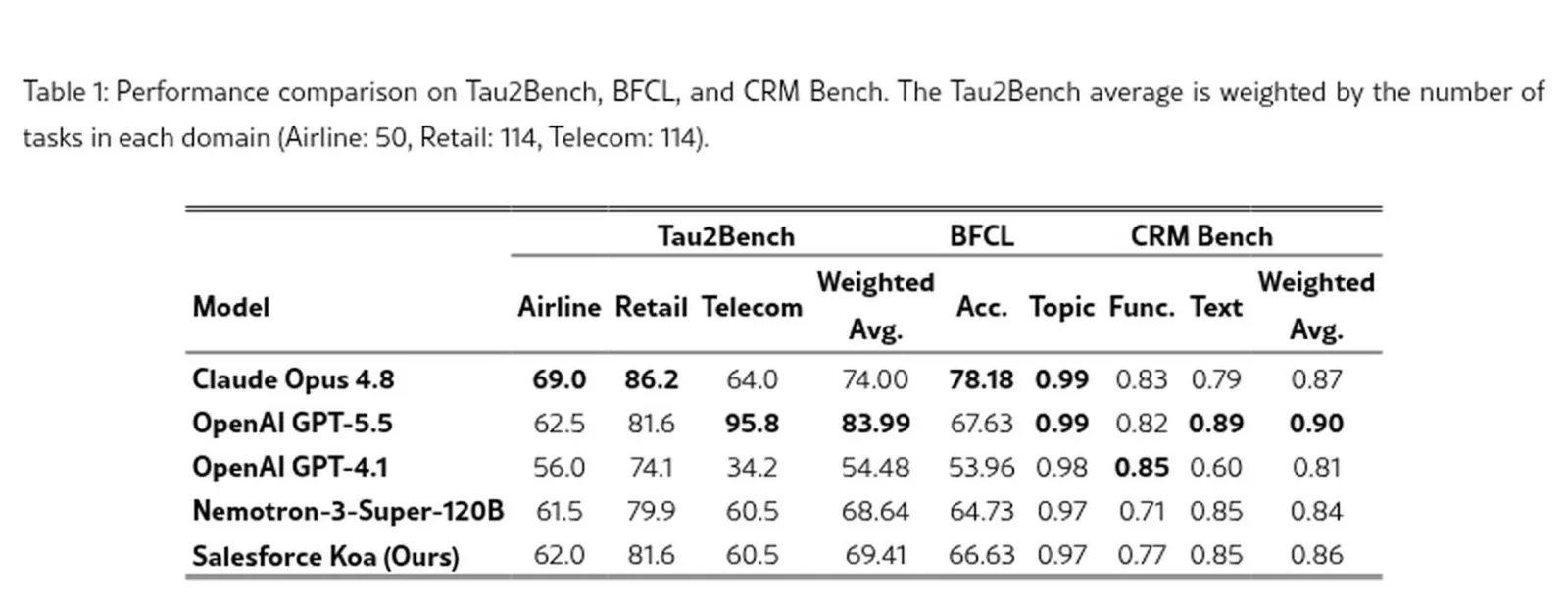
The research paper "Salesforce Koa: An Enterprise Language Model for Agentic Tool Use," written by 25 authors from Salesforce and submitted to arXiv on Monday, contains a table. On CRM Bench: GPT-5.5 scores 0.90, Claude Opus 4.8 0.87, Koa 0.86, the base Nemotron 0.84, GPT-4.1 0.81. The authors' conclusion: Koa "surpasses a strong proprietary baseline (GPT-4.1) while remaining below the strongest frontier models." The most measurable gain from post-training is tool-call accuracy on CRM Bench, up from 0.71 to 0.77. The phrase "three times fewer errors" is nowhere in the paper, and no pair of numbers in the table produces a threefold difference. There are more discrepancies: the press release describes supervised fine-tuning and reinforcement learning, while the paper says the finished model is reinforcement learning applied directly to the base, with no SFT stage. Jason Andersen of Moor Insights: "That is Salesforce grading its own test, so I would treat the specific numbers as a claim to watch rather than settled fact."
What actually changed
Not that Koa is the best. It's that it exists. Jayesh Govindarajan, EVP of Salesforce AI, in TechCrunch: "reasoning has always been something that we've relied on the frontier model providers for. Until now." Three weeks ago Salesforce announced Claudeforce: Claude is the default model in Slack and in the Agentforce Coworker and Vibes agents, and according to Benioff the company is spending roughly $300 million on Anthropic tokens this year, almost entirely on coding (neither company has officially confirmed the figure). Koa replaces nothing; it becomes the fourth model provider you can pick in Setup. But a company with 30,000 Agentforce customers has shown that an open model, synthetic data and a few dozen GPUs are enough to build your own reasoning model. Why Nemotron? Govindarajan: "We have no idea what Qwen trains on," and until now there was no American open frontier-class model with clear data provenance. Jensen Huang onstage, as reported by Nvidia: the share of open models went from 30% at the beginning of last year to some 70% now.
Outside LinkedIn the response was muted. Two Hacker News threads with two points each; nobody even submitted the TechCrunch piece headlined "everything the AI labs should fear." Nvidia has not written the word "Koa" in a single post on X. On r/salesforce the one thread has 1 point, and commenters read "27 years of CRM intelligence" their own way: "so what they are saying is that they used the last 3 decades customers data to train their proprietary model? No one saying anything?" Salesforce says no, and the paper repeats it. But that is what trust looks like after two years of Agentforce promises.
If you run Salesforce in the U.S., you are first in line for once: general availability is slated for your regions this winter, with the price still unannounced. Everyone else is left waiting with no timeline set. Nemotron does not officially support most European languages either, so the European rollout is a matter of both regulation and language.
On Saturday the head of Anthropic called on the labs to slow down. On Tuesday one of their largest customers showed it is building its own model just in case. It is called Koa, Hawaiian for "brave." That was the name of Benioff's golden retriever, whom the company has long presented as its mascot with the title "Chief Love Officer."
Reasoning model - a model that lays out its reasoning step by step and picks tools before answering, instead of replying immediately. Post-training - further training of a finished model for specific tasks, cheaper than training from scratch. Frontier - the strongest models at a given moment, here GPT-5.5 and Claude Opus 4.8. Agentforce - Salesforce's platform for building AI agents; usage is billed per conversation ($2) or per action (10 cents), among other options.